

If you attended a traditional elementary school, high school, or college, you’ve likely experienced the impact of different teaching styles, even if you never used that phrase before. Think about the teachers who made lessons click for you and the ones who made learning feel confusing or dull. The difference often comes down to how they taught, not just what they taught.
Teaching styles shape how information is explained, practiced, and remembered. They influence whether students stay engaged, feel confident enough to try new ideas, or quietly check out halfway through a lesson.
If you’re an online instructor, corporate trainer, educator, or course creator, understanding teaching styles helps you design lessons that actually work. Instead of guessing what will keep students engaged, you can choose approaches that match your subject, your students, and the way people learn online.
In this article, you’ll learn the 5 most common teaching styles, the pros and cons of each, examples of how they work, and strategies to choose and apply them to your online courses or training programs.
Follow along or skip ahead:
- The top 5 most effective teaching styles you need to know
- How to apply different teaching styles to online courses
- The most effective teaching methods
- Choosing a teaching style for today’s learners
- Adapting to different teaching and learning styles
- 3 expert tips to make your teaching styles more effective
- FAQ’s
The top 5 most effective teaching styles you need to know
Here’s a quick overview of the main 5 teaching styles you need to know. Each have a different approach, and audience they are best suited for. In this article, you’ll learn about each to find the best fit for you and your learners.
| Most effective teaching styles | Best for | Overview | Pros | Cons |
| Lecturer | Best for teaching large groups | Teacher takes a central roleInformation is delivered in a structured, organized mannerFormal, authority style teaching | Easy to prepare lecturesOpportunity to teach large groupsClear, organized structure to learning content | Limited personalized interactionsLow information retentionNo active learning |
| Demonstrator | Best for teaching practical, hands-on topics | Teacher demonstrates concepts or skills using visual aids, activities, and examples Teacher is open to student-centered learning | Incorporates range of teaching formatsLearners often take a hands-on approachLearners can ask questions for immediate clarification | May not be suitable for all topicsNot accommodating of all learners’ needsRequires adequate resources and preparation |
| Hybrid | Best for teaching a diverse range of learners | Balance between teacher- and student-centered learning experienceTeachers can adjust teaching style to keep learners engaged | Adaptable to needs of diverse learnersWide variety of activities and approachesMix of structure and improvisation | Can be challenging to find a balance between teaching methodsMay be slower to teach information-heavy materialMay be less focused than other teaching styles |
| Facilitator | Best for teaching critical thinking and communication skills | Student-centred approach where teacher facilitates Encourages inquiry-based learningCentered on critical thinking, questions, and discussing real-world case studies | Encourages self-sufficency in learnersHelps improve problem-solving skills and critical thinkingFosters collaboration and communication skills | Less suitable for theory-heavy topicsTakes skill to guide discussions effectivelySlower than other methods |
| Delegator | Best for teaching peer-to-peer activities | Teachers take the role of an observerThe most student-centric teaching styleLearning happens through collaboration and discussions | Encourages collaboration and social learningIndividualized learning experiencesPromotes problem-solving and decision-making skills | Can be challenging for some learnersNot suitable for some topicsCan be less efficient than other teaching styles |
The most effective teaching styles depend heavily on the topic and material you’re teaching, as well as your class or cohort size, and learners’ unique needs.
Here are the top five teaching styles you need to know, take a look at the image below to see just how broad your teaching can be.
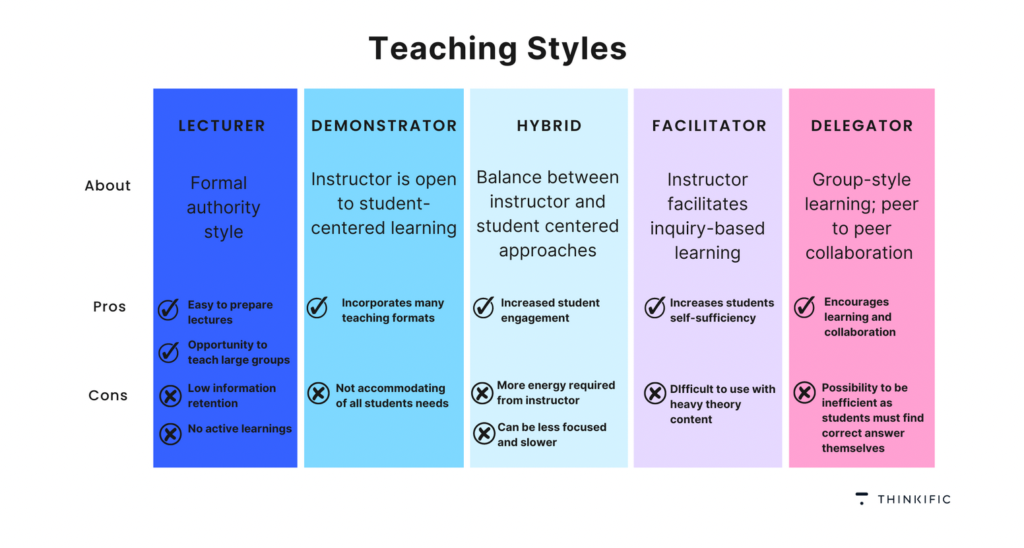
1. Lecturer Teaching Style
Best for: Teaching very large groups of learners
The lecturer style – sometimes called the formal authority style – will be familiar to anyone who’s sat through long lectures in giant college or university auditoriums.
In this teaching style, the teacher takes a central role and delivers information to a large group of students in a structured, organized, and unidirectional manner. The subject matter is usually singular and predetermined.
Since there are often many learners in each group, there isn’t enough room or time for personalized interactions between the teacher and students. However, students are encouraged to take notes and ask questions at the end of each lecture. There are usually no additional activities planned.
How this works in practice
An example of the Lecturer teaching style in action is when a guest speaker is invited to a school or a corporate setting to give a presentation. After the guest speaker presents the topic for an hour or so, they encourage learners to ask questions, especially if there’s anything they don’t understand or would like clarified. Learners can also ask for more details about a particular aspect of the teaching content.
This teaching style allows educators to deliver large amounts of information to learners in a focused way. It’s fast and efficient. But due to the lack of learner participation, it has limited knowledge retention, and students may struggle to engage with the content being taught.
“I’m really big on making sure that you don’t have a bunch of fluff in your product—that you’re not just making it look pretty—but you’re actually concerned with the content inside of it.”
— Diamond Lee, Thinkific Creator Educator
Pros of the Lecturer teaching style
- Possible to teach large groups of students at once
- Easy to prepare lectures in advance
- Provides a clear structure and organization to learning content
- Can be time-effective in covering a broad range of material
- Suitable for dense, information-heavy topics
Cons of the Lecturer teaching style
- Limited student engagement and interaction
- Learners are not able to actively engage with the lecturer, apart from asking questions at the end
- Limited knowledge retention
- This teaching method does not cater to diverse learning styles
2. Demonstrator Teaching Style
Best for: Teaching practical, hands-on topics
The Demonstrator teaching style often goes beyond formal lectures to demonstrate concepts or skills to learners. Under the demonstrator style, the teacher still retains a lot of authority but is more open to trying a student-centered approach to teaching.
You can often see the demonstrator encouraging students to come up with problem-solving strategies, ask questions, and simulate what they’ve just learned.
The Demonstrator teaching style might include:
- Using visual aids e.g. presentations, images, and films
- Hands-on activities
- Practical examples
- Experiments
How this works in practice
An example of the demonstrator teaching style in action is when a teacher conducts a science experiment or an art workshop in a classroom. Learners may huddle around the demonstrator to observe and participate in the experiment or workshop.
When the teacher is done with the demonstration, they encourage learners to emulate the processes they’ve observed and conduct their own experiments or activities to create the same or similar results.
As the learners work through the activity, the teacher is there to provide them with visual aids and multimedia to enforce key concepts and principles and answer any questions they may have regarding the project. The teacher may also encourage peer sharing and feedback, which helps students to actively engage in the learning process.
Thanks to its flexible, practical approach to teaching, this teaching style is applicable to a wider range of learning styles compared to the more traditional lecture teaching style.
“I’m a big proponent of reaching out to students… I want to see how they’re doing, if they have any issues, and what setbacks and roadblocks they’re experiencing.”
— Diamond Lee, Thinkific Creator Educator
Pros of the Demonstrator teaching style
- Incorporates a variety of teaching formats
- Hands-on learning can enhance students’ understanding of subject matter
- Visual aids and demonstrations can make concepts more memorable
- Students can ask for immediate clarification through examples and practical applications
Cons of the Demonstrator teaching style
- Less suitable for large groups
- Doesn’t accommodate the needs of all students
- This teaching style may not be suitable for all subjects or topics
- This style requires adequate resources and preparation, which can be hard if the teacher is short on time, has a low budget, or limited capacity
- During a demonstration, there’s often less time to cover a large amount of content
3. Hybrid Teaching Style
Best for: Teaching a diverse range of learners
The hybrid teaching style – also known as blended teaching – strives to strike a balance between both teacher- and student-centered approaches. This teaching style integrates both traditional and modern teaching methods, making it ideal for adapting to the needs of diverse learners.
Teachers who follow a hybrid teaching style often bring their own knowledge and expertise into the class. They usually have a structure for every lesson but they are able to adjust their flow and come up with a range of activities to keep students engaged.
A hybrid teaching style can integrate a wide range of teaching tools into one session, including:
- Lectures
- Demonstrations
- Group activities
- Technology
How this works in practice
A hybrid teacher may assign online readings or videos for learners to review before class. There can also be an online discussion forum where learners share insights, questions, and ideas. In class, learners can build upon the online discussion with hands-on activities, group discussions, or problem-solving tasks related to the material they studied, as well as opening up new areas for exploration.
This varied approach to teaching allows educators to cater to a diverse range of learners’ needs and continually adapt the content to keep learners engaged, putting a new spin on the content depending on the individual students in the class.
But although the hybrid approach is effective across a variety of settings, it can be challenging to cover information-heavy courses due to its slower pace.
“Myself and 15 other people could be teaching the same thing, but they’re not going to be me. So if you just sit with yourself and realize that thing that’s different about you – that you’re known for – you’ll be successful… Figure out what that thing is and incorporate it into your content or teaching style and watch how you build a layer of visibility and credibility based off of being authentically you.”
— Diamond Lee, Thinkific Creator Educator
Pros of the Hybrid teaching style
- This teaching style uses a variety of methods that cater to diverse student needs
- Integrates both traditional and modern approaches for a balanced learning experience
- Gives teachers the flexibility to adapt to different learning preferences
- Students remain active and engaged for longer
Cons of the Hybrid teaching style
- This teaching style requires extensive planning
- Needs careful coordination of different teaching elements
- Finding the right balance between traditional and modern teaching methods may be challenging
- Dependent on the available resources and technology
- It can be less focused and slow than other teaching styles
- It requires a lot of energy from the teacher
Related: The Best Online Teaching Platforms to Earn Money in 2026
4. Facilitator Teaching Style
Best for: Teaching critical thinking and communication skills
Shifting to an even more student-centered approach, the facilitator style of teaching focuses on inquiry-based learning.
Instead of giving one-directional lectures, a facilitator encourages students to learn by thinking critically, asking questions, and discussing real-world case studies. Additional activities might be designed to improve problem-solving skills and help learners understand the subject matter better through practical challenges and examples.
How this works in practice
- Socratic seminar
A Socratic seminar promotes Socrates’ belief that asking questions, inquiring about things, and engaging in constructive debate are the best ways to learn.
In a Socratic seminar, students seek a deeper understanding of complex or vague ideas through thoughtful dialogue and divergent thinking.
Here is a brief breakdown of this teaching style:
- The facilitator provides a specific topic or text for students to read through and think about before the class
- In the class, the facilitator poses open-ended questions to stimulate critical thinking
- The students answer the facilitator’s questions and argue for or against a motion
- Students also share ideas, opinions, and build on each other’s responses to get an in-depth and well-rounded understanding of the topic.
- Case study analysis
This is where the facilitator presents a real-life case study related to the subject matter and then prompts a class discussion where learners analyze the case, identify key issues, and offer solutions to the problem. The teacher guides the discussion without dominating it, encouraging critical thinking and collaboration among students.
This teaching style is effective for promoting communication and cooperation between learners, encouraging them to interrogate a topic and come up with their own ideas and answers. It fosters a teaching environment based on open discussion and exploration. But it may not be suitable for teaching highly technical topics.
“Life is hard enough. We don’t need to make it harder on ourselves by creating this image that we’re so professional and rigid; no one can connect with that… We need to be personable and connect with our target audience because they’ll probably never meet you in person.”
— Diamond Lee, Thinkific Creator Educator
Pros of the Facilitator teaching style
- The teacher provides guidance and support rather than direct instruction
- This teaching style helps students develop self-sufficiency
- It fosters critical thinking, collaboration, and communication skills
- It supports student-centered learning and autonomy
Cons of the Facilitator teaching style
- This style doesn’t work well for theory-heavy or technical classes
- It requires a skilled facilitator to guide discussions effectively
- It may take more time to cover content compared to traditional methods
- Learners may need additional support if they’re not accustomed to this teaching method
5. Delegator Teaching Style
Best for: Teaching peer-to-peer activities
The most student-centric teaching style of all is the delegator style – also known as the group style. Here, the teacher is merely present as an observer, and it’s the group of learners who are doing all the work.
Most of the learning in the delegator teaching style occurs among learners on a peer-to-peer basis through frequent discussions, collaboration, and communication. The instructor is practically removed from the position of authority and only facilitates the discussions.
How this works in practice
The delegator style works best for lab-based experiments, group tutoring classes, creative writing, debates, and other peer-to-peer activities.
In these activities, the teacher divides the class into small groups and assigns each group a project related to the course content. The students are responsible for planning, executing, and presenting their findings, while the teacher acts as a mentor, providing guidance and support throughout the project.
This approach encourages students to take ownership of their education and become self-directed learners.
“When people hit rough patches, they’re able to coach each other through it… It’s a community for the students to be able to go on their learning journey together.”
— Diamond Lee, Thinkific Creator Educator
Pros of the Delegator teaching style
- This teaching style encourages learning and collaboration among students
- It allows for individualized learning experiences
- It promotes the development of problem-solving and decision-making skills
- It encourages self-sufficiency and independence
Cons of the Delegator teaching style
- This teaching style can be inefficient since students have to find the right answers for themselves
- It may not be suitable for all subjects or students
- It’s less suitable for theory-heavy or technical topics
How to apply different teaching styles to online courses
Online courses give you a lot of flexibility in how you teach. You’re not limited to lectures or live sessions, so you can combine video lessons, exercises, discussions, and projects to match the teaching style that best supports your students.
Here are some effective ways to apply each teaching style when designing an online course.
- Lecturer style – Structured video lessons that explain core concepts
The Lecturer style works well when you need to teach foundational knowledge or explain complex ideas step by step. In an online course, this usually takes the form of clear, well-structured video lessons.
- Start by breaking your topic into short modules that build on each other. Each lesson should focus on one idea and move logically to the next. This helps students follow the material without feeling overwhelmed.
- Add simple support materials, such as lesson summaries, downloadable notes, or quick quizzes that check understanding. These small checkpoints help students stay engaged and confirm they understood the lesson before moving forward.
For example, if you’re a finance instructor, you could explain budgeting principles through a series of short lectures, followed by a worksheet where students categorize their expenses.
- Demonstrator style – Show the process while students follow along
The Demonstrator style focuses on showing how something works in real time. Instead of just explaining an idea, you walk students through a process so they can see it in action.
In online courses, this often means using screen recordings, step-by-step walkthroughs, or recorded demonstrations. Students watch the process first and then repeat it on their own. This style works especially well for practical topics such as design, coding, marketing tools, or software tutorials.
For example, Kevin Powell, a front-end web developer, often records coding tutorials and posts them to his YouTube channel. In his Build a Responsive Website with HTML & CSS series, he records himself coding a full website.

Students can code alongside him as they watch his videos, building their own website using the same steps. This makes the learning experience much more active.
- Hybrid style: Combine explanations, demonstrations, and practice
The Hybrid teaching style blends several teaching approaches within the same course. Many online courses naturally use this style because different topics require different types of instruction.
You might begin a module with a short lecture that explains a concept. Then follow it with a demonstration that shows how the concept works in practice. Finally, give students an exercise or a small project so they can apply what they learned.
For example, in a digital marketing course, you might:
- Explain the basics of audience targeting
- Demonstrate how to create a target audience in an ad platform
- Ask students to build their own targeting strategy
- Host a Slack discussion where you give feedback on each student’s strategy
This approach keeps lessons varied and helps students move from understanding to real application.
- Facilitator style – Guide discussions and collaborative learning
The facilitator style shifts the focus from teaching to guiding. Instead of delivering most of the information yourself, you help students explore ideas through discussion, reflection, and shared experiences.
Online courses can support this style through community spaces (like Slack or Discord) and discussion activities. Many instructors use discussion boards, cohort groups, or live sessions to create conversations around the course material.
For example, after introducing a concept, you might ask students to share how it applies to their own work. Other students can comment, offer suggestions, or compare experiences.
You can also include prompts such as:
- Reflect on a challenge you faced related to this topic
- Share how you would apply this method in your own project
- Review another student’s work and provide feedback
Your role is to guide the conversation, highlight useful insights, and help students connect ideas.
- Delegator style – Give students projects and independent learning paths
The delegator style focuses on independent learning. Instead of walking students through every step, you give them resources, frameworks, and challenges so they can explore the topic on their own.
In an online course, this often takes the form of larger projects or assignments. Students apply what they have learned while making their own decisions along the way.
For example, in a course on starting a business, you might ask students to create their own business plan. You provide templates, examples, and guiding questions, but students choose their idea, research their market, and develop their strategy.
This approach works best when students already understand the fundamentals. Your role shifts from instructor to mentor. You provide direction, feedback, and resources while students take ownership of the learning process.
The most effective teaching methods
Short answer: There is no single teaching style that works best in every situation.
The most effective teaching method depends on several factors, including the subject you’re teaching, the goals of the lesson, the experience level of your students, and the learning environment. A method that works well for teaching theory may not work as well for teaching practical skills.
In this guide, we focused on five of the most common teaching styles used by educators today. However, these are not the only ones.
Depending on the system or school of thought you look at, there are even more teaching styles out there – as described in a paper titled Teaching Styles and Language Performance by Edgar R. Eslit and Mercedita B. Tongson.
The book, The Spectrum of Teaching Styles in Physical Education, defines 11 distinct teaching styles that can be used to teach learners across a range oflearning environments.
In general, educational researchers define at least five distinct teaching styles along a spectrum that moves from teacher-centered instruction to student-centered learning.
Here’s a table showing the difference between the two approaches:
| Aspect | Teacher-centered approach | Student-centered approach |
| Definition | A teaching approach where the instructor leads the lesson and delivers most of the information. Students mainly listen, take notes, and follow instructions while the teacher guides the learning process. | A teaching approach where students take an active role in the learning process. The instructor acts as a guide while students explore ideas, participate in activities, and learn through discussion, collaboration, and practice. |
| Teacher’s role | The teacher serves as the primary source of knowledge, explains concepts, selects lesson topics, and evaluates student performance. | The teacher supports learning by asking questions, guiding discussions, providing feedback, and helping students work through problems. |
| Student’s role | Students primarily receive information, complete assignments individually, and rely on the instructor for explanations and answers. | Students actively participate in learning, share ideas, collaborate with peers, and often reflect on or evaluate their own progress. |
| Learning structure | Lessons usually follow a clear, structured format led by the teacher, such as lectures, demonstrations, or guided exercises. | Lessons often include interactive elements such as discussions, group work, projects, or problem-solving activities. |
| Common learning activities | Lectures, note-taking, demonstrations, quizzes, and instructor-led explanations. | Discussions, peer learning, collaborative projects, case studies, and hands-on practice. |
Most educators naturally lean toward one approach or another. However, the most effective instructors adjust their teaching strategies to match their students and the learning process at hand.
In practice, many courses combine elements of both approaches to create a more engaging and effective learning experience.
Choosing a teaching style for today’s learners
The best teaching style for students depends on your topic, your learners, and the environment you’re teaching in.
A Hybrid teaching style is ideal for teaching a diverse range of learners as it’s flexible, allowing you to adapt your teaching style to students’ preferences, learning needs, and backgrounds.
But as you can see from the list above, each style of teaching has its pros and cons. So there’s no definitive winner here — instead, try mixing and matching teaching styles based on the situation.
When preparing your course content, imagine which teaching style might help your students learn the material the easiest. And don’t be afraid to play around a bit.
Try experimenting with different teaching styles to see what works and double down on what’s most effective for your learners.
“I’m very comfortable jumping into something even if it’s scary. Coming from an education background, I really try to instill this whole sense of, ‘It’s okay to fail. Good things can come from things not going well. If something goes wrong, I can always improve it.’”
— Meredith Austin, Thinkific Creator Educator
Adapting to different teaching and learning styles
The best way to adapt teaching styles to different learning styles is to use a mix of teaching methods and adjust them based on how your students learn best. Combining explanations, demonstrations, discussions, and hands-on activities helps you reach learners with different preferences and learning speeds.
Different students shine under different teaching approaches. This is because every student has their own learning style (we’ve written about the seven main types of learning styles here).
The cooperative learning style, for example, which requires more group work and collaboration, pairs well with the facilitator or delegator teaching style. And the Interactive learning style, where learners actively engage and participate in lessons, is often a great fit for the demonstrator or facilitator teaching styles, too.
It’s very likely that your primary teaching style won’t be purely one of the big five discussed above, but rather an ever-changing mix that would be unique to you and the students you teach.
If you’re looking to adapt your teaching style to different learning styles, take the time to get to know your individual students and what types of learning environments they thrive in. Then adapt your teaching as you go.
As students learn better by different approaches and at different speeds, try to adjust your teaching style on the fly to maximize the learning opportunity for all.
3 expert tips to make your teaching styles more effective
To help you create the best possible learning experience for your learners, here are some expert tips from Thinkific Creator Educators who have successfully built thriving learning businesses that showcase their creative teaching styles.
- Talk to your individual learners
When you’re creating learning content, try to speak to your learners as individuals, rather than as a large group. Aim to make your content a conversation.
This method helps make sure your content is engaging and interactive by keeping the individual learners at the heart of your teaching. What do they most want to hear from you? How will you reach those individuals and keep them locked in to every word you say?
“I continually asked myself… How am I going to teach these standards in an engaging way? What needs are my core understandings fulfilling? What understanding do I want my teachers to come away with?”
— Meredith Austin, Thinkific Creator Educator
If you can imagine you’re speaking to an individual – and think about every individual in every class – it can help you to automatically adjust your learning content to suit a diverse range of learning styles. You also have a sounding board for every piece of content you create.
And if you’re not sure whether or not it works? Ask a real life learner for their feedback.
“I also have a muse that I’m writing the course for. So I’ll think, ‘what does Emily need to understand? Where do I need to take her so that she can apply these techniques in her business with confidence?’ This is what lays the foundation for all of my online courses.”
— Fiona Humberstone, Thinkific Creator Educator
- Think about the problem you’re trying to solve
Many teachers and educators find it helpful to focus on solving a specific problem when they’re creating learning content. By zeroing in on a set of problems you’re trying to help your students solve, you can craft more compelling learning outcomes that resonate with your learners – and your customers.
“When I sit down to create a mindmap, I always think first, ‘What kind of journey do I need to take my students on? Where do I want my students to be at the end? What problem is my online course solving? What am I hearing that people are struggling with?”
— Fiona Humberstone, Thinkific Creator Educator
This method can also help you to structure your learning content. If you focus on the problem your learners need to solve – whatever that may be – you can make sure that every piece of content you produce is bringing them one step closer to that goal.
“It’s about providing a solution where if someone didn’t solve the problem, it would greatly affect their life.”
— Diamond Lee, Thinkific Creator Educator
Pro tip: Knowing the problem you’re solving for learners is also an effective way to make your marketing messaging pop. If you can understand your learners’ core priorities and pain points, you can make sure your marketing content speaks directly to them. Whether on social media, email, or via your website content.
- Build a community to encourage social learning
Whatever teaching styles you choose, building a community around your course can help to enhance and facilitate learning for your students.
By building a learning community, you can give your learners a space to connect, share, and learn beyond the classroom, opening up new opportunities for discussions and fresh insights.
If you’re looking to monetize your courses, building a community also opens up opportunities to connect with your learners and customers – helping to encourage reconversions and turn past students into brand advocates. Plus, your community can become a digital product in its own right, too.
“My first round of BAM graduated two years ago, and they’re able to network and respond to newer members’ questions in the Slack community, as well as share their experiences, insights and stories of their journey.”
— Kat Lee, Thinkific Creator Educator
Start creating inspiring online learning experiences today
Here at Thinkific, we’re dedicated to making it easier for teachers and educators to deliver impactful, inspiring, and unforgettable learning experiences to their students.
We have some of the best teachers in the world in our ranks who have learnt how to engage and enthrall their learners with every lesson.
Ready to join the movement?
Create your own impactful learning experiences, and embrace your own unique teaching style with Thinkific’s intuitive and easy-to-use platform, built for learning professionals, teachers and educators,
Create, market, and sell engaging courses online using Thinkific’s suite of AI-powered, no-code tools, and reach more learners across the world with your content. The platform adjusts easily to various teaching styles, depending on your learners’ needs. Add multimedia materials, including presentations, videos, quizzes, and more.
Also, build your own member communities to encourage and facilitate social learning and open up your learners’ eyes to what’s possible.
Get started with Thinkific for free today to see how easy creating your first learning product can be.
FAQs
1. What are the 5 teaching styles?
The five teaching styles commonly discussed in education are:
- Lecturer: The instructor explains concepts through structured lessons or presentations
- Demonstrator: The instructor shows how to complete tasks or apply a process
- Hybrid: A mix of lectures, demonstrations, discussions, and activities
- Facilitator: The instructor guides the discussion and helps students explore ideas
- Delegator: Students take more responsibility for projects and independent learning
Most educators use a mix of these styles rather than relying on just one.
2. How do I choose which teaching style to use for a particular lesson or course?
Start with your learning goal and subject matter. If students need to understand concepts first, a lecturer or hybrid approach works well. If they need to develop practical skills, demonstrator, facilitator, or delegator styles are usually more effective.
Also consider your class size, available time, and the level of interaction you want. Many instructors combine styles in the same course, such as explaining a concept first and then moving into discussion or hands-on practice.
3. What is the main difference between teacher-centered and student-centered teaching styles?
In a teacher-centered approach, the instructor leads the lesson and delivers most of the information. Students mainly listen, take notes, and complete assignments individually.
But in a student-centered approach, learners take a more active role. They discuss ideas, collaborate with peers, and apply what they learn while the teacher guides and supports the process. Many modern courses combine elements of both approaches.
4. Why is a hybrid teaching style often recommended for today’s students?
A hybrid teaching style combines explanation with interaction. You might start with a short lecture, demonstrate a concept, and then give students an activity to practice it. This approach keeps lessons structured while still encouraging participation. It also works well with diverse groups of learners who benefit from different types of instruction.
5. What teaching style works best for online learning?
Online learning often works best with a hybrid approach. Courses usually combine short lectures, demonstrations, discussions, and assignments to keep students engaged.
For example, you might include video lessons to explain concepts, walkthroughs to demonstrate processes, and exercises or projects where students apply what they learned. This mix keeps online courses practical and interactive.
6. How can I adapt my teaching style to different learning styles in one group?
Use variety in your lessons. Combine explanations, visuals, demonstrations, discussion, and practice activities instead of relying on just one format.
Watch how students respond during lessons and adjust when needed. If students engage more during discussions or hands-on work, you can increase the time spent on those activities in future lessons.
7. What are the common pitfalls of relying only on lectures, and how can I reduce them?
Lectures are efficient for delivering information, but they can lead to low engagement and poor retention if students only listen.
You can improve lecture-based lessons by keeping them short and adding interaction. Ask questions, include quick exercises, or follow the lecture with a discussion or demonstration to help students apply what they learned.
8. When does a facilitator or delegator style work best, and when should I avoid them?
Facilitator and delegator teaching styles work well when your goal is to build critical thinking, collaboration, or independent problem-solving. They are common in seminars, workshops, and project-based learning.
However, they’re less effective when students are new to a topic or when you need to explain complex concepts quickly. In those cases, start with clear instructions before moving into discussion or independent work.
9.How do I know my teaching style?
Look at how you usually teach. Do you spend most of your time explaining ideas, demonstrating processes, guiding discussions, or assigning projects?
You can also ask students for feedback and notice when they learn best. Many instructors discover they naturally use a combination of styles, and that mix often becomes their teaching style over time.